
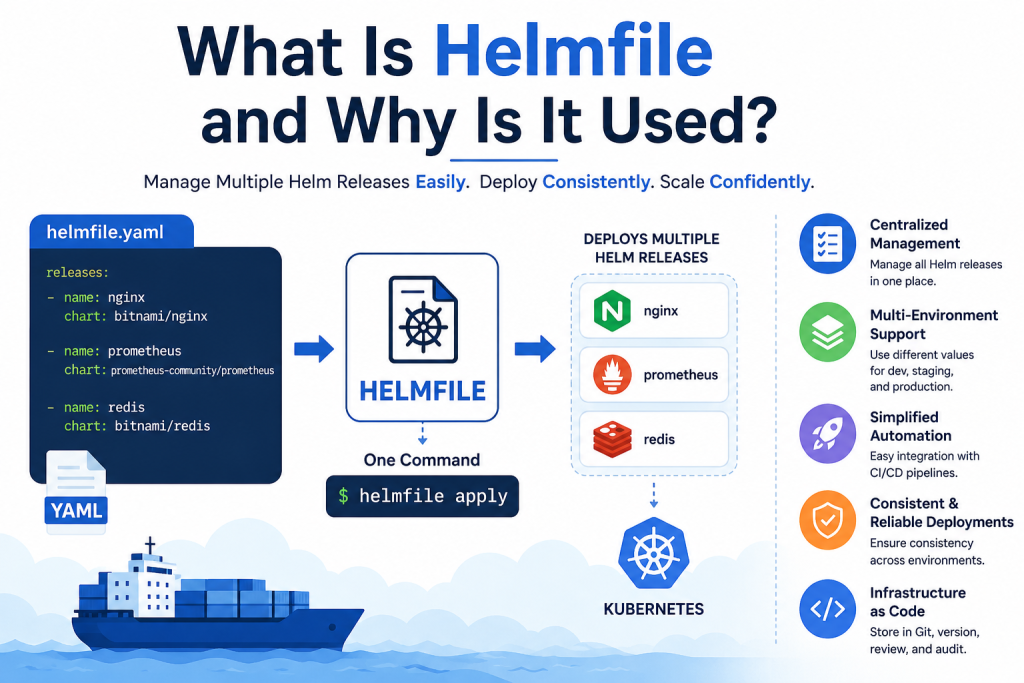
As Kubernetes environments grow, organizations often deploy multiple applications, databases, monitoring tools, and supporting services. Managing each Helm release separately can become time-consuming and prone to errors. Helmfile simplifies this process by allowing teams to define all Helm releases in one place and apply them consistently across different environments.
Instead of running numerous Helm commands manually, users can describe their desired infrastructure state in a YAML file. Helmfile then synchronizes the actual cluster state with the configuration, making deployments more predictable and easier to maintain.
Understanding Helm Before Helmfile
To understand Helmfile, it is important to know what Helm does.
Helm is often called the package manager for Kubernetes. It allows developers and operators to install, upgrade, roll back, and manage Kubernetes applications using packages known as Helm charts.
A typical Helm command might look like this:
helm install my-app ./chartThis works well for a single application. However, when an organization manages multiple services across development, staging, and production environments, the number of commands and configuration files can become difficult to manage.
This is where Helmfile becomes valuable.
How Helmfile Works
Helmfile acts as a layer on top of Helm. Instead of manually executing Helm commands for each application, users create a helmfile.yaml file that describes all desired releases.
A simple example looks like this:
releases:
  - name: nginx
    chart: bitnami/nginx

  - name: prometheus
    chart: prometheus-community/prometheus
With this configuration, Helmfile can deploy and manage both applications together using a single command:
helmfile applyHelmfile automatically determines what changes need to be made and executes the appropriate Helm operations.
Key Reasons Why Helmfile Is Used
Centralized Release Management
One of the biggest advantages of Helmfile is centralized management. Teams can define all Helm releases in a single file or organize them into multiple files for large projects.
This makes infrastructure easier to understand and maintain because everything is documented in one location.
Simplified Multi-Environment Deployments
Most organizations maintain several environments, such as development, testing, staging, and production.
Helmfile allows users to define environment-specific values and configurations without duplicating deployment logic.
For example:
environments:
  dev:
    values:
      - dev-values.yaml

  prod:
    values:
      - prod-values.yaml
This approach reduces configuration drift and ensures consistency across environments.
Improved Automation
Helmfile integrates well with CI/CD pipelines. Instead of writing complex deployment scripts, teams can simply run:
helmfile applyThis makes automated deployments easier, more reliable, and less error-prone.
Dependency Management
Applications often depend on supporting services such as databases, monitoring systems, or ingress controllers.
Helmfile allows teams to define release ordering and dependencies, ensuring components are deployed in the correct sequence.
Better Infrastructure as Code Practices
Modern DevOps teams prefer storing infrastructure configurations in version control systems such as Git.
Helmfile supports Infrastructure as Code (IaC) principles by allowing deployment configurations to be tracked, reviewed, and audited like application code.
Common Helmfile Commands
Helmfile provides several useful commands for managing Kubernetes deployments.
Preview Changes
Before applying updates, users can review planned changes:
helmfile diffThis command displays differences between the current cluster state and the desired configuration.
Apply Changes
To synchronize the cluster:
helmfile applyThis command installs, upgrades, or removes releases as needed.
Synchronize Releases
Users can also explicitly synchronize releases:
helmfile syncDelete Releases
To remove managed releases:
helmfile destroyThese commands help simplify Kubernetes operations while reducing manual effort.
Benefits of Using Helmfile
Helmfile offers several advantages for Kubernetes management.
It reduces repetitive Helm commands, making deployments faster and easier to maintain. Teams gain better visibility into their infrastructure because all releases are defined in a structured format. Environment-specific configurations become easier to manage, and deployment consistency improves significantly.
Another major benefit is scalability. As Kubernetes environments grow, Helmfile continues to provide a manageable way to control large numbers of Helm releases without increasing operational complexity.
Helmfile vs Helm
Although Helmfile and Helm work together, they serve different purposes.
Helm focuses on deploying and managing individual applications using charts. Helmfile focuses on orchestrating multiple Helm releases and managing them collectively.
Think of Helm as the engine that performs deployments, while Helmfile acts as the control center that coordinates those deployments across an entire Kubernetes environment.
When Should You Use Helmfile?
Helmfile is especially useful when:
- You manage multiple Helm charts.
- You maintain several Kubernetes environments.
- You need consistent deployments across clusters.
- Your team follows Infrastructure as Code practices.
- You want easier CI/CD integration.
- You need centralized release management.
For small projects with only one or two Helm charts, Helm alone may be sufficient. However, as infrastructure grows, Helmfile quickly becomes an essential tool for simplifying Kubernetes operations.
Conclusion
Helmfile is a powerful configuration management tool that enhances Helm by enabling teams to manage multiple Kubernetes deployments from a single, declarative configuration. It simplifies release management, improves automation, supports multi-environment deployments, and aligns with modern Infrastructure as Code practices.
For organizations running complex Kubernetes environments, Helmfile helps reduce operational overhead, improve consistency, and make deployments more predictable. By combining the strengths of Helm with centralized configuration management, Helmfile has become an important tool in many DevOps and cloud-native workflows.